
Multiple myeloma: Full guide
What is multiple myeloma?
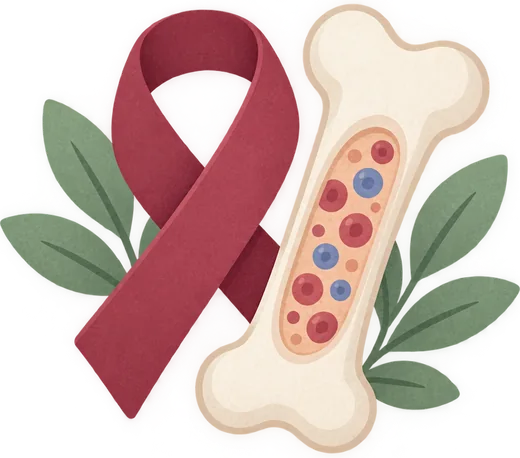
Multiple myeloma is a cancer of plasma cells. Plasma cells are white blood cells that live in the bone marrow. Bone marrow is the soft, spongy tissue inside your bones where blood cells are made. Healthy plasma cells make antibodies, which are proteins that help fight infection.
In myeloma, one plasma cell grows out of control and makes many copies of itself. These copies all make the same abnormal protein, called M-protein (monoclonal protein). The extra cells crowd out healthy blood cells. They can also weaken bones and harm the kidneys.
Myeloma often starts slowly. Many people first have a quiet, early condition called MGUS. Some go on to a middle stage called smoldering myeloma. Most people with MGUS never develop active myeloma. Smoldering myeloma is more likely to turn into active myeloma, so it is watched closely.
Myeloma is more common in older adults. Most people are around 70 when they are diagnosed. It is about twice as common in Black Americans as in White Americans, and a bit more common in men.
Myeloma is usually not curable today. But it is very treatable. Treatments have improved a great deal in recent years, and many people now live for many years with good quality of life.
Types and related conditions
- MGUS (monoclonal gammopathy of undetermined significance)
- A common, harmless-looking condition where a blood test finds a small amount of M-protein, but there is no cancer damage. It does not need treatment. Only about 1 in 100 people with MGUS move on to myeloma each year, so your care team will check your blood from time to time.
- Smoldering myeloma
- More abnormal plasma cells or M-protein than MGUS, but still no damage to bones, kidneys, or blood. Most people are watched closely without treatment. People at high risk of it turning into active myeloma may be offered treatment or a clinical trial.
- Active multiple myeloma
- Myeloma that is causing damage (such as bone breaks, kidney problems, anemia, or high calcium), or lab and scan results that show damage is very likely soon. This is the stage that needs treatment.
- Light chain myeloma
- A form where the myeloma cells make only a small piece of the antibody protein, called a light chain. It is found with a blood test called free light chains or with a urine test. It can be harder on the kidneys.
- Solitary plasmacytoma
- A single tumor made of plasma cells, in a bone or soft tissue, without myeloma in the rest of the marrow. It is often treated with radiation. Your care team will watch for signs of myeloma later.
- Plasma cell leukemia
- A rare, faster-growing form where myeloma cells show up in the bloodstream. It needs strong treatment right away.
- High-risk myeloma
- Myeloma with certain gene changes or features that make it more likely to come back sooner. It is still treatable. Your care team may suggest stronger or longer treatment.
- Monoclonal gammopathy of clinical significance (MGCS)
- A rare situation where a small amount of M-protein, even without cancer, harms a body part such as the nerves, skin, or kidneys. It may need treatment aimed at the plasma cells.
Tests you may have
- Serum protein electrophoresis (SPEP) and immunofixation
- Blood tests that find and measure the M-protein and show what type it is. The M-protein level is one of the main ways your care team tracks how myeloma is doing over time.
- Serum free light chains
- A blood test that measures the small light chain proteins. It helps find myeloma that makes only light chains, and it helps track treatment.
- Urine tests
- You may be asked to collect all your urine for 24 hours. This measures M-protein in the urine and helps check the kidneys.
- Blood counts and chemistry
- A complete blood count checks for anemia (low red blood cells). Other blood tests check calcium, kidney function, albumin, beta-2 microglobulin, and LDH. Some of these help stage the myeloma.
- Bone marrow biopsy
- A needle takes a small sample of marrow, usually from the back of the hip bone. You get numbing medicine first. The sample shows how many plasma cells there are and is used for gene tests.
- Imaging scans
- A whole-body low-dose CT scan, PET-CT scan, or whole-body MRI looks for bone damage. These scans find more than plain X-rays. They also help find spots before they cause pain or breaks.
- MRD testing
- MRD means minimal residual disease. It is a very sensitive test on a bone marrow sample that can find as few as 1 myeloma cell among 100,000 or more normal cells. It is done when treatment is working very well.
- Blood type and screen before daratumumab or isatuximab
- These drugs can confuse blood bank tests. Your care team will check your blood type before you start, so a transfusion can be matched safely later. Tell any hospital that you are on one of these drugs.
What the stage means
Myeloma is not staged like many other cancers, by tumor size or spread. Instead, doctors first decide where you are on the path from MGUS to smoldering myeloma to active myeloma.
For active myeloma, doctors look for signs of damage, often called CRAB. C is high calcium. R is kidney (renal) problems. A is anemia. B is bone damage. Any one of these, plus enough myeloma cells, means active myeloma. Some lab or MRI findings also count as active myeloma even without CRAB, because damage is very likely soon.
Doctors then use a staging system called the ISS (International Staging System). Newer versions, called R-ISS and R2-ISS, add LDH and gene test results. Stage helps your care team understand how fast the myeloma may act. It does not decide your whole future, and people at every stage are treated.
- Stage I
- Lower levels of beta-2 microglobulin, normal albumin, and no high-risk gene changes or high LDH. This usually means the myeloma is less aggressive.
- Stage II
- Results that fit neither stage I nor stage III. This is the most common group.
- Stage III
- A high beta-2 microglobulin level, plus high-risk gene changes or a high LDH in the R-ISS version. This myeloma may act faster and may need closer follow-up.
- CRAB: high calcium
- Myeloma can release calcium from bones into the blood. This can cause thirst, constipation, confusion, and kidney problems.
- CRAB: kidney problems
- The M-protein and light chains can clog and damage the kidneys. Drinking fluids and quick treatment can help protect them.
- CRAB: anemia
- When myeloma crowds the marrow, fewer red blood cells are made. This can cause tiredness and shortness of breath.
- CRAB: bone damage
- Myeloma can make holes in bones called lytic lesions. These can cause pain and breaks, often in the back, ribs, or hips.
Lab tests and risk features
Myeloma cells can have changes in their chromosomes (the packages that hold genes). A test called FISH on your bone marrow sample looks for these changes. Some changes mean the myeloma may come back faster. This is called high-risk myeloma.
Knowing your risk features helps your care team choose how strong your treatment should be and how long to continue maintenance. Ask your care team which features your myeloma has.
- del(17p) or TP53 change
- A missing piece of chromosome 17. It is one of the most important high-risk features. It often leads to stronger or longer treatment.
- t(4;14)
- A swap of material between chromosomes 4 and 14. It is a high-risk feature. Some drugs, such as bortezomib and carfilzomib, work well against it.
- t(14;16) and t(14;20)
- Other chromosome swaps that are linked to higher-risk myeloma.
- 1q gain or amplification
- Extra copies of part of chromosome 1. It is now counted as a high-risk feature in newer staging systems.
- t(11;14)
- A chromosome swap that is usually standard risk. Myeloma with this change can respond to a drug called venetoclax, which is sometimes used in later treatment.
- Hyperdiploid myeloma
- Myeloma cells with extra copies of several chromosomes. This is usually a standard-risk feature.
- Beta-2 microglobulin and albumin
- Two blood tests used in the ISS staging system. A higher beta-2 microglobulin and lower albumin suggest more active disease.
- LDH
- A blood test that can be high when myeloma is growing fast. It is part of R-ISS staging.
- Response and MRD
- During treatment, your care team measures how much the M-protein drops. Complete response means no M-protein can be found. MRD-negative means even the very sensitive marrow test finds no myeloma cells. Being MRD-negative is linked to longer control of the myeloma.
Main treatments
- Watching closely (for MGUS and smoldering myeloma)
- MGUS and most smoldering myeloma are not treated. Instead you have regular blood tests and sometimes scans. For high-risk smoldering myeloma, a drug called daratumumab (given as a shot under the skin) is now FDA approved to delay active myeloma. A clinical trial is another option.
- Induction with a 4-drug combination (quadruplet)
- Induction is the first treatment to get the myeloma under control. For most newly diagnosed people, this now means 4 drugs together: an antibody (daratumumab or isatuximab), a proteasome inhibitor (bortezomib, or sometimes carfilzomib), an immune-modifying pill (lenalidomide), and a steroid (dexamethasone). You may hear this called Dara-VRd or Isa-VRd. It is usually given in cycles over several months.
- Autologous stem cell transplant
- Your own stem cells are collected from your blood and frozen. You then get high-dose chemotherapy (melphalan), and your stem cells are given back to rebuild your marrow. It can keep myeloma away longer. Not everyone needs or can have one, and some people save it for later. Age alone does not rule it out. Ask your care team if it fits you.
- Treatment if transplant is not planned
- Many people do not have a transplant because of age, other health issues, or personal choice. They often get a quadruplet or a 3-drug combination, and then keep taking treatment. Doses can be adjusted for older or frailer people to limit side effects.
- Maintenance therapy
- After induction (and transplant, if done), most people keep taking a lower-intensity treatment for a long time, often until it stops working. Lenalidomide pills are the most common. People with high-risk myeloma may add another drug, such as daratumumab or bortezomib. Maintenance helps keep the myeloma in check longer.
- Treatment at relapse
- Myeloma usually comes back at some point. This is called relapse. There are many good options. Your care team will usually switch to drugs from a different group than the ones you had before, such as carfilzomib, pomalidomide, or a different antibody.
- CAR-T cell therapy
- Your own T cells (a type of immune cell) are collected and changed in a lab to find and attack myeloma cells. They target a protein on myeloma cells called BCMA. The two approved products are cilta-cel (Carvykti) and ide-cel (Abecma). They are given once, after a short course of chemotherapy, at a specialized center. They are now used as early as the first or second relapse.
- Bispecific antibodies
- These drugs grab a myeloma cell with one arm and a T cell with the other, so your immune system attacks the cancer. They are shots or infusions given on a regular schedule. Examples are teclistamab, elranatamab, and linvoseltamab (which target BCMA) and talquetamab (which targets a different protein called GPRC5D). They are available off the shelf, with no waiting for cells to be made.
- Other targeted drugs
- Belantamab mafodotin is an antibody that carries a drug into myeloma cells. It is used with bortezomib and a steroid after earlier treatments. It can affect the eyes, so you will need regular eye exams. Other options include selinexor and, for people with the t(11;14) change, venetoclax.
- Radiation and bone care
- Radiation can ease pain from a bone spot, treat a single plasmacytoma, or protect the spinal cord. Most people with active myeloma also get a bone-strengthening drug (see below).
Common side effects and what helps
- Fatigue
- Feeling very tired is common from myeloma, anemia, and treatment. Gentle daily activity like walking, good sleep habits, and planning rest can help. Tell your care team, because anemia can often be treated.
- Numbness or tingling (neuropathy)
- Bortezomib and thalidomide can cause numbness, tingling, or burning in the hands and feet. Report it early. Your care team can change the dose or schedule before it gets worse. Giving bortezomib as a shot under the skin, once a week, lowers the risk.
- Infections
- Myeloma and its treatments weaken the immune system. You may take medicines to prevent shingles, pneumonia, and other infections. Stay up to date on flu, COVID, and pneumonia vaccines. Some people get IVIG, an infusion of antibodies, if they keep getting infections.
- Blood clots
- Lenalidomide, pomalidomide, and thalidomide raise the risk of blood clots. Most people take aspirin or a blood thinner to prevent them. Watch for leg swelling or sudden shortness of breath.
- Low blood counts
- Low platelets can cause easy bruising or bleeding. Low white cells raise infection risk. Your care team checks your counts often and can pause or adjust treatment.
- Diarrhea or constipation
- Long-term lenalidomide and some other drugs can cause diarrhea. A medicine that binds bile acids often helps. Thalidomide tends to cause constipation. Drink fluids and tell your care team about any change.
- Steroid side effects
- Dexamethasone can cause trouble sleeping, mood swings, higher blood sugar, and increased appetite. Taking it in the morning can help sleep. Doses are often lowered over time.
- Cytokine release syndrome (CRS) and nerve effects from CAR-T and bispecifics
- CRS is a strong immune reaction that can cause fever, chills, low blood pressure, or trouble breathing. It is usually mild and happens in the first days or weeks. Some people have confusion or trouble with words. Rarely after CAR-T, movement problems like Parkinson's disease can appear later. You will be watched closely, often in or near the hospital, and should stay close to your center at first.
- Taste, skin, and nail changes from talquetamab
- Talquetamab can change taste, make swallowing harder, cause weight loss, and cause dry skin or nail changes. Your care team can help with diet tips and dose changes.
- Jaw bone problems from bone-strengthening drugs
- Rarely, zoledronic acid or denosumab can cause osteonecrosis of the jaw, where a part of the jaw bone does not heal. See a dentist before starting. Avoid tooth extractions during treatment if you can, and tell your dentist you take these drugs.
Living with and after multiple myeloma
For most people, myeloma is a long-term illness that is managed over many years, a bit like other chronic conditions. There are often periods of good control, sometimes long ones, followed by a need to change treatment. Many good options now exist for each step.
Protecting your bones matters. Most people with active myeloma get zoledronic acid or denosumab, often for 1 to 2 years or longer, to lower the risk of breaks. Do not stop denosumab on your own, because stopping suddenly can raise the risk of spine fractures. Ask your care team about safe exercise, calcium and vitamin D, and what to do for back pain.
Protect your kidneys. Drink plenty of fluids unless told otherwise. Avoid pain pills like ibuprofen and naproxen unless your care team says they are okay. Ask before getting scans that use contrast dye.
Preventing infection is part of daily life. Wash your hands often, stay away from people who are sick, and keep up with vaccines your care team recommends. Call right away if you get a fever.
You will have regular blood tests to track the M-protein and light chains. These tests often show relapse before you feel any symptoms. That gives time to plan the next step calmly.
Caregivers carry a lot too. CAR-T and bispecific treatment usually need a caregiver nearby for the first weeks. Ask about social workers, support groups, and help with travel and costs. Groups like the International Myeloma Foundation, the Multiple Myeloma Research Foundation, and Blood Cancer United (formerly the Leukemia and Lymphoma Society) offer free support.
Call your care team right away if you have
- Fever of 100.4 F (38 C) or higher, or shaking chills
- New or sudden back pain, or new numbness, weakness, or trouble walking or controlling your bladder or bowels (this can mean pressure on the spinal cord)
- Confusion, extreme sleepiness, strong thirst, or severe constipation (signs of high calcium)
- Passing much less urine than usual, or swelling in the legs
- Swelling, pain, or warmth in one leg, or sudden shortness of breath or chest pain (possible blood clot)
- Bleeding that will not stop, black stools, or many new bruises
- After CAR-T or a bispecific antibody: fever, dizziness, trouble breathing, confusion, trouble speaking or writing, shaking, or unusual sleepiness
- A painful rash with blisters on one side of the body (possible shingles)
- New vision changes or eye pain, especially if you take belantamab
- Sudden, severe pain after a minor fall or movement (possible broken bone)
Sources
- NCI PDQ: Plasma Cell Neoplasms (Including Multiple Myeloma) Treatment (Patient Version)
- American Cancer Society: Multiple Myeloma
- NCCN Guidelines for Patients
Last updated: 2026-10-27. Medically reviewed by Veli Bakalov, MD, medical oncologist (October 2026). General education from Step by Step, the patient portal of HemeOncBuddy.